

Picking a tech stack feels like choosing forever. You're not just picking tools for today; you're committing to a foundation that will either help your product scale or slow it down.
In this guide, we'll walk through how to choose languages, frameworks, and cloud platforms for your next app so it's fast today and still easy to maintain in a few years.
Why Your Tech Stack Matters
A bad tech choice doesn't just slow development. It makes your codebase brittle, hiring harder, and growth painful. A smart tech stack stays out of your way and lets you focus on users, not debugging infrastructure.
- Fast development so you can ship features quickly
- Easy for new developers to understand and work on
- Stable and widely used so you're not gambling on the next trend
- Built for the scale you're actually targeting
Tech Stack Checklist: Questions To Ask
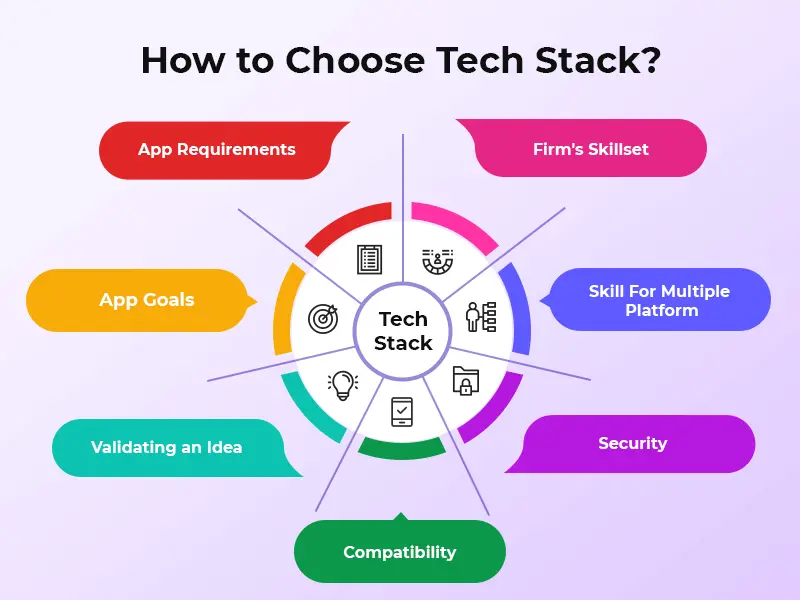
Before you commit to a framework or platform, ask yourself:
- How fast do we need to ship? (MVP in weeks vs. polished product in months)
- Who will maintain this code after launch? (Your team, a contractor, or an agency?)
- How many users do we expect in year one? (Affects database and server choices)
- Any new brand guidelines, logos, or visuals
The 5-Step Tech Stack Decision
1. Define Your Product Type Different products need different stacks. A marketing website, a SaaS app, and a mobile app each have different speed and complexity requirements. Start by being honest about what you're actually building.
2. Pick A Frontend Framework That Fits For web apps, React, Vue, or Next.js are solid choices. For mobile-first products, consider React Native or Flutter. The goal is something your developers already know (or can learn quickly) and that ships fast.
3. Choose A Backend Approach Decide between traditional servers (Node.js, Django, Laravel), serverless (AWS Lambda, Google Cloud Functions), or a headless CMS. Each has trade-offs between speed, cost, and flexibility.
4. Pick A Database That Won't Betray You PostgreSQL is rock-solid for most apps. MongoDB works for document-heavy products. Firebase is a quick start if you're bootstrapped. Pick one that's well-supported and doesn't require constant babysitting.
5. Deploy To A Scalable Cloud Platform AWS, Google Cloud, and DigitalOcean all work. The difference is less about which cloud you pick and more about whether you set it up right: containers, auto-scaling, and monitoring from day one.
"We chose a boring, proven tech stack and shipped our MVP in half the time other teams in our industry took. Now we're scaling without having to rewrite anything."